
Loading…
Loading…
Trucker Tools
Led technology transformation at Trucker Tools, modernizing a decade-old logistics platform while reshaping engineering strategy around reliability, scalability, AI, and business growth.

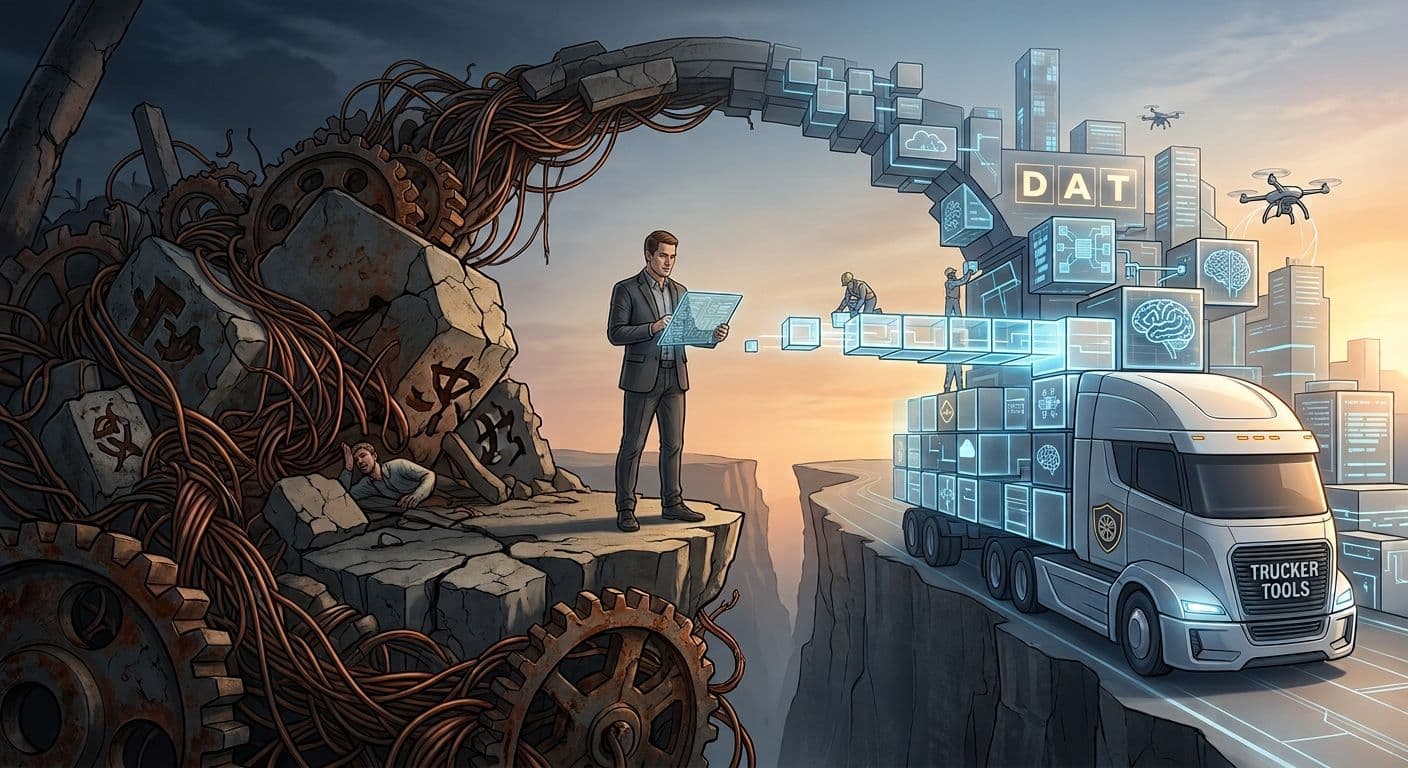
When I joined Trucker Tools, the company had spent roughly a decade building and evolving its logistics technology platform. The product was deeply embedded in the business, but that history had also created significant technical debt.
The challenge was not simply to make the software "more modern." The technology organization needed to become a better engine for the business: more reliable, more scalable, faster to develop, and capable of supporting new products without continually increasing complexity.
As Director of Technology, I had overall responsibility spanning engineering leadership, architecture, infrastructure, product development, and technology strategy while remaining hands-on in the technical work.
The initial strategy was ambitious: rearchitect the platform at a fundamental level. The vision was to break apart tightly coupled systems, modernize the architecture, establish stronger engineering practices, and create a foundation that could support the company's next phase of growth.
But architecture is ultimately a business decision. As the work progressed, it became clear that a large-scale rewrite would consume too much engineering capacity relative to the immediate business opportunity. The technically elegant solution was not necessarily the economically optimal one.
So I changed the strategy.
Rather than attempting to replace the platform wholesale, I shifted the organization toward incremental modernization.
High-value shared capabilities were extracted into dedicated AWS Lambda services. The most problematic areas of the monolithic codebase were progressively isolated, while lower-value technical debt was treated as a long-tail investment rather than something that needed to be eliminated immediately.
We also used external engineering capacity strategically for dependency upgrades and other work that did not require core product expertise.
This allowed the team to modernize the architecture while preserving engineering capacity for customer-facing product development. The result was a technology strategy that balanced three things that are often treated as competing priorities:
The transformation extended beyond architecture. I worked across engineering, product, and company leadership to establish priorities, reshape teams, define technical standards, and connect technology investment to measurable business outcomes. That meant making difficult tradeoffs about where engineering time should go, and, just as importantly, where it should not.
The organization also began applying AI as a product capability. New AI-driven capabilities became a meaningful part of the company's revenue, demonstrating that the technology organization could create new business opportunities rather than simply maintain existing systems.
During my tenure, platform uptime improved from roughly 75% to 99.8%, while cloud costs decreased by 29%. AI-driven products ultimately represented approximately 15% of annual recurring revenue.
The work helped establish a more scalable technology foundation while allowing the company to continue investing in growth. Trucker Tools was subsequently acquired by DAT in 2024.
The experience reinforced a principle I carry into every technology organization:
The best architecture is not the one that looks best on a diagram. It is the one that creates the most leverage for the business.
More work
View all work
CONNEQT
Built CONNEQT into a modern home automation and integration company focused on bringing networking, security, audio, automation, and connected technology together into cohesive, reliable systems.
Temp
Architected a self-service cloud platform enabling global teams to build, deploy and innovate securely at scale.

Capital One
Led modernization of a core platform from Java monolith to microservices on cloud, improving velocity, reliability, and customer experience.